Look Before You Climb

James Carter
| 12-05-2026
 · Sport team
Watch a competitive climber at an event before they start a route.
They stand on the ground, arms moving, bodies shifting, eyes locked on the wall. It looks theatrical, but it’s actually route reading—pre-climbing the sequence in mind and body before committing.
Studying the route on the ground saves energy, prevents confusion, and reduces falls. Skipping this step forces reactive climbing, solving problems mid-wall. Route reading front-loads the thinking, so your body can focus on moving—not figuring out what’s next.
Step 1: Look at the Whole Route First
Before examining individual holds, step back far enough to see the entire route from bottom to top. The overview reveals information that close inspection misses: the general line, where the wall angle changes, any obvious crux sections (identifiable as clusters of small holds or unusually large moves), and potential rest positions. Look for places where the holds seem bigger or more positive — those are likely rest spots where body weight can be managed on the feet while the arms recover.
Identify the finish hold, then trace the line backward to the start. This reversal — reading from top to bottom rather than bottom to top — helps identify the crux section without getting fixated on early moves. The crux is where most attempts fail; understanding it from the ground avoids being surprised by it when already tired from the lower section.
Step 2: Read Hold Orientation, Not Just Hold Location
Most beginners look at a route and see where the holds are. Experienced climbers look at how the holds are oriented — and that distinction determines everything. A jug facing downward is an undercling requiring an upward pull; approached as a normal jug, it's useless. A sideways crimp is a sidepull requiring lateral tension rather than a downward pull. Misreading orientation is one of the main causes of getting stuck on a move that looked easy from below.
From the ground, check each hold: which way does it face? Up = pull down normally, sideways = sidepull, downward = undercling, toward you from above = gaston. The hold’s orientation tells you how to position your body.
Step 3: Read the Clues the Wall Gives You
In a climbing gym, holds leave two kinds of traces that reveal how experienced climbers use them. Chalk marks show where hands grip — including the specific position on the hold. A chalked thumb print on the side of a sloper reveals that the hold is being used as a pinch rather than a pure sloper. Chalk concentrated on only one part of an edge indicates the usable zone. Climb shoe rubber marks on footholds show exactly where successful climbers step — particularly useful for identifying non-obvious footholds on blank sections of wall.
Look at these traces as evidence rather than instructions. They show what has worked before and help identify where beginners might look for foot placements they'd otherwise miss entirely.
Step 4: Mime the Sequence (Air Karate)
Once the handholds and their orientations are identified, mime the sequence from the ground. Arms move through the reaches, the body turns where hip rotation will be needed, one leg lifts to approximate the footwork. This physical rehearsal encodes the sequence into muscle memory before the consequences of being wrong include falling off the wall.
Focus the miming on the crux sequence and the transition into and out of it. Many climbers rehearse the hard move extensively but forget the two or three moves before it that determine body position and fatigue level going in. Identify a specific marker hold that signals the approach to the crux — something visible from the wall — so that when climbing, the plan can be recalled and executed deliberately rather than improvised.
Keep the foot sequence in mind during the mime: if a foot swap will be needed at a specific move, rehearse the swap. Small, chip-type footholds with no chalk and rubber marks are foot-only holds — the route setter placed them specifically to be stepped on. These are often missed by beginners who only scan for handholds, and missing them means relying on the arms for a section the setter intended the feet to handle.
Step 5: Revise on the Wall, Don't Abandon the Plan
The ground plan rarely survives the route unchanged — and that's expected. The plan's purpose is to give a structure to modify rather than improvise from scratch. As the climb progresses, the pre-planned sequence provides a reference: when a move feels wrong or unexpectedly hard, the comparison to the plan reveals what might need adjustment. Maybe a hold is turned slightly differently than expected, or the foothold assumed to be available is too small. These are quick adjustments, not restarts.
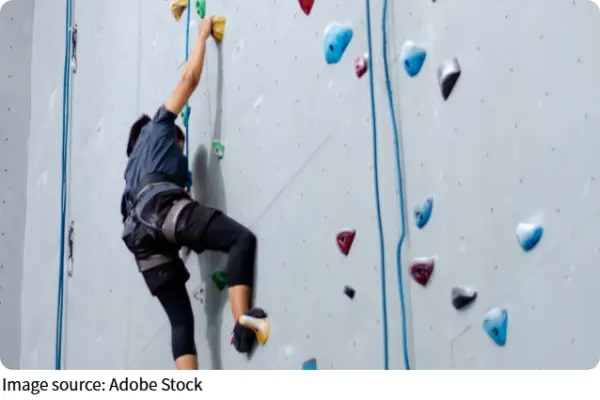
The habit of reading before climbing builds faster than almost any other technique practice. Dedicate the first two minutes of every route attempt to ground observation: overview, hold orientation, clues on the wall, mime. Progress in this skill becomes visible within just a few sessions — routes that previously required multiple attempts start yielding earlier, and the experience of being surprised mid-route by unexpected holds diminishes steadily.