The Brass Rebel

Declan Kennedy
| 12-05-2026
 · Art team
Imagine a musical instrument designed with the precision of a telescope but the vocal range of a soul singer.
In the rigid, orchestral world of the 19th century, the saxophone was a mechanical anomaly—a "misfit" born from a desire to bridge the gap between the power of brass and the agility of woodwinds.
It is the only instrument in the common repertoire that didn't slowly evolve from ancient reeds; it was engineered from scratch by Adolphe Sax. To play a saxophone is to operate a complex machine of levers and springs that translates human breath into a physical specimen of vibration. It isn't just an instrument; it is a disruptive technology that changed the "SOP" of modern music.
The Hybrid Mechanical Blueprint
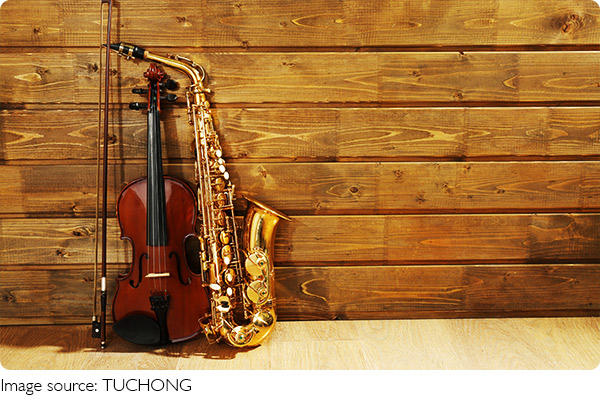
The fascination with the saxophone begins with its paradoxical construction. It is made of brass, yet it is classified as a woodwind. This isn't an arbitrary label; it is a matter of "acoustic logic." The sound is generated by a single cane reed vibrating against a mouthpiece—the same mechanism as a clarinet—but it is amplified through a conical brass bore.
This conical shape is the secret to its "overblowing" mechanism. While a clarinet jumps an octave plus a fifth when pushed, a saxophone jumps exactly one octave. This makes the fingering system logical and intuitive for the human hand. The instrument is a network of approximately 25 keys, each padded with leather and airtight resonators, connected by a series of stainless steel needle springs. When you press a key, you aren't just making a note; you are activating a high-precision mechanical linkage that must seal a hole with zero margin for "atmospheric leakage."
A Spectrum of Sonic Specimen
One of the most interesting aspects of the saxophone is the sheer variety within its family. Each version is a specialized tool designed for a specific frequency range.
The Four Core Saxophone Tiers
• Soprano: The high-pitched, often straight-bodied variant. It requires the highest "embouchure tension" and is known for its piercing, oboe-like clarity in the upper register.
• Alto: The most common "entry-point" specimen. Its size is ergonomically perfect for the average human reach, offering a balance between bright projection and warm tonal depth.
• Tenor: The heart of the jazz movement. It features a signature "neck crook" (the S-curve) which adds a slight resistance to the airflow, resulting in a husky, rich harmonic profile.
• Baritone: The heavy-duty machine of the section. It utilizes a "loop" in the upper tubing to wrap several meters of brass into a manageable frame, producing low-frequency vibrations that you can feel in your chest.
The Aerodynamic Challenge
Playing the saxophone is a study in fluid dynamics. The player must maintain a consistent "air column" while the volume of the instrument's interior space changes constantly as keys open and close. This creates a shifting "back-pressure" that the performer must manage through diaphragm control.
Unlike a piano, where the mechanical strike of a hammer produces a fixed tone, the saxophone allows for "pitch bending." By manipulating the vocal tract and the pressure on the reed, a player can fracture a note or slide between frequencies. This "fluidity" is what allows the instrument to mimic the human voice. Modern "extended techniques" even involve "multiphonics," where the player uses specific fingering combinations to force the air to split, creating a dissonant, chord-like sound from a single tube.
The Voice of the Misfit
The saxophone's history is a reminder that being "uncategorizable" is a strength. It was too loud for the classical strings and too refined for the standard brass bands, so it carved its own path through jazz, rock, and blues. It found its home among the rebels and the innovators who didn't fit into the traditional boxes.
Reflect on your own "mechanical" makeup: Are you trying to force yourself into a category that doesn't fit your internal blueprint? The saxophone teaches us that you can be made of one material but speak with the soul of another. True interest lies in the hybridity—the ability to be powerful yet agile, metallic yet warm. Have you embraced your own "hybrid logic," or are you still trying to play a brass part with a woodwind heart? Success isn't about fitting in; it's about finding the specific frequency where your unique construction finally resonates.
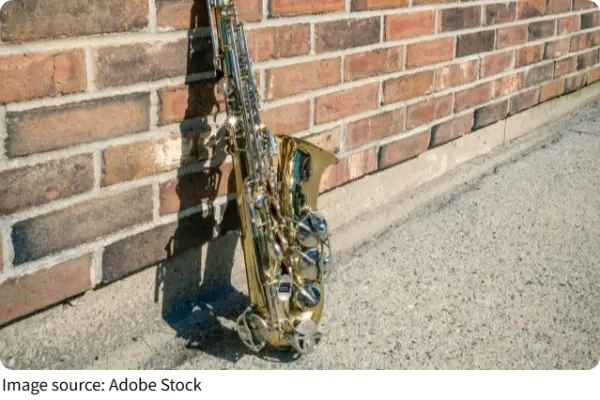
The saxophone remains one of the most distinctive inventions in modern music — an instrument built from contradiction yet defined by harmony. Combining the strength of brass with the expressive soul of a woodwind, it created a voice that could move effortlessly between precision and emotion. From classical halls to jazz clubs and contemporary stages, the saxophone proved that originality often comes from refusing to fit into a single category. Its story is not only about musical innovation, but also about identity, adaptability, and finding power in uniqueness.