Smokies: America's Free Park

Raghu Yadav
| 15-05-2026
 · Travel team
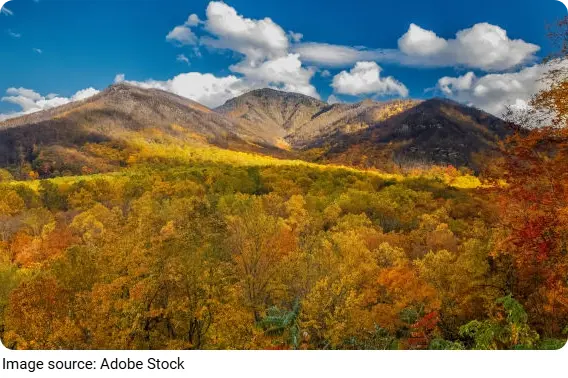
Morning fog hangs low over the ridgelines, turning every mountain view into something almost dreamlike.
That haze — the one that gives the park its name — isn't just atmosphere.
It's actually a natural phenomenon caused by the dense vegetation releasing water vapor into the air. The Great Smoky Mountains National Park spans the border of Tennessee and North Carolina, covers over 522,000 acres, and holds the title of the most visited national park in the United States. More than 10 million people show up every year. And here's the kicker — there's no entrance fee.
Getting There
A car is essential here. There's no public transit to the park from any major city, so plan to drive or rent. On the Tennessee side, McGhee Tyson Airport (TYS) near Knoxville is the closest — about 1 hour 15 minutes from the Sugarlands Visitor Center. On the North Carolina side, Asheville Regional Airport (AVL) sits roughly 60 miles from the Cherokee entrance. Both airports have car rental options. Once you're in the park, it's all driving and hiking.
Bicycles are only allowed on three specific trails: the Gatlinburg Trail, the Oconaluftee River Trail, and the lower Deep Creek Trail.
Fees & Parking
No entrance fee — but there is a parking tag required if you're leaving your car for more than 15 minutes. A daily pass costs $5, and a weekly pass is $15. Important note: the Smokies are not covered by the America the Beautiful annual pass, so don't count on that here. Purchase tags at any visitor center, at automated machines (credit card only), or in advance at recreation.gov. If you buy online, print it out and leave it on the dash — digital doesn't cut it.
Great Smoky Mountains National Park
What to See & Do
Newfound Gap Road is the main scenic drive cutting through the heart of the park. On a clear day, the overlooks are absolutely stunning. On a cloudy day? It's still worth it — this is the Smokies, after all, and that moody haze is part of the whole experience.
Cades Cove is a must. An 11-mile one-way loop through an open valley surrounded by mountains, with old historic homesteads, and great wildlife sightings — elk, deer, turkeys, the occasional black bear. Budget 2 to 4 hours for the full loop during peak times. Go close to dusk for smaller crowds and better wildlife chances.
Kuwohi (formerly called Clingmans Dome) is the highest point in the park at 6,643 feet — third highest peak east of the Mississippi. A short but steep paved trail leads to an observation tower with 360-degree views across the Smokies. The road to it closes from early December through late March, so plan accordingly.
Waterfalls are everywhere. More than 100 cascades and falls are scattered throughout the park. Abrams Falls (5 miles, moderate) and Laurel Falls (2.4 miles, easy) are the most popular. For something less crowded, the hike to Alum Cave Bluffs rewards with dramatic rock formations and mountain views the whole way up — 4.5 miles round trip with about 1,160 feet of elevation gain.
Best Time to Visit
Summer is the busiest season but also when everything is lush and green. Fall is spectacular — foliage typically peaks from mid-September through early November, and weekdays during that window are much more manageable than weekends. Winter brings fewer crowds but also possible road closures, especially in higher elevations where roads sometimes don't open until 9am and close by 5pm. Spring is genuinely underrated — wildflowers, low prices, and smaller crowds.
Where to Stay
Where you base yourself matters a lot. Gatlinburg on the Tennessee side is convenient but comes with serious traffic on Highway 441 near the park entrance — long lines are common. A smarter move is to stay near the Cherokee entrance on the North Carolina side, where most of the scenic overlooks along Newfound Gap Road are also more accessible. Townsend, TN is another good option — quieter, closer to Cades Cove, and right by the scenic Foothills Parkway.
Inside the park, there are 10 developed campgrounds with sites starting around $17–$25 per night. Elkmont and Cades Cove campgrounds are the largest and most popular — reserve well in advance, especially for summer and fall. Outside the park, hotels in Gatlinburg and Pigeon Forge range from around $100 to $250+ per night depending on season.
Asheville, about 75 minutes away, offers a wider range of accommodation with more character — boutique hotels, B&Bs, and good restaurants — and it remains a solid base if you're spending multiple days exploring the park.

The Great Smoky Mountains don't perform for you — they just exist, quietly, the way they have for centuries. Fog rolls through the valleys, elk graze in Cades Cove at dusk, and waterfalls crash behind moss-covered rocks without an audience. Show up, breathe deep, and let the Smokies do what they do best: remind you that some things are still wild, free, and wonderfully unhurried.