Voice Inside the Car

Camille Dubois
| 20-05-2026
 · Automobile team
The old version of in-car voice control had one primary failure mode: it made you feel like you were talking to a vending machine.
Memorize the right phrase, say it clearly, wait for the beep. Deviate from the expected syntax by even a word and you'd get an error, or worse, the wrong action entirely.
That interaction paradigm is being replaced — quickly — and the technology behind the shift is substantial.

What's Under the Hood
A modern in-car voice assistant runs on a stack of distinct but integrated components. Automatic Speech Recognition (ASR) converts the driver's spoken input into text, handling background noise, engine sounds, HVAC hum, and whatever music is playing. Natural Language Understanding (NLU) then interprets the meaning of that text — identifying intent, extracting relevant entities, and tracking conversational context across multiple turns.
A Dialog Management layer maintains state across the conversation, remembers what was said earlier in the exchange, and determines what response or action to generate. Finally, a Text-to-Speech (TTS) engine delivers the response in natural-sounding voice.
The significant change in recent years is the integration of large language models into the NLU and dialog layers. Previous systems relied on hand-crafted intent classifiers with fixed slot-filling schemas — they could only understand what they were explicitly programmed to handle. LLMs trained on broad language data can handle paraphrase, ambiguity, implicit context, and multi-step requests without needing every variant pre-programmed.
Mercedes-Benz integrated a conversational AI layer into its MBUX Voice Assistant, allowing drivers to ask open-ended questions and get contextually relevant answers rather than requiring rigid command syntax. The system also moves vehicles toward being the center of a driver's digital life rather than just a navigation and entertainment device.
The UX Design Challenge
Technical capability and user experience are not the same thing, and the automotive context creates specific UX constraints that don't exist in phone-based assistants. The driver cannot look at a screen to confirm what the system heard. Feedback must be auditory, brief, and not distracting. Errors during driving are not just frustrating — they pull attention off the road.
A well-designed Voice User Interface (VUI) recognizes accents, dialect variations, and even emotional cues in the driver's voice. It should be inclusive across a wide range of speakers without asking anyone to unnaturally simplify their language.
Personalization goes further than recognition. A family SUV driver may prefer a friendly, supportive assistant tone; a driver of a performance vehicle may want something more direct and minimal. Brands are increasingly treating the voice assistant's personality as an extension of the vehicle brand itself — the way the assistant speaks, the vocabulary it uses, and the level of expressiveness all carry brand identity signals.
Build vs Buy: A Strategic Choice for Automakers
One of the central decisions facing car manufacturers is whether to build a proprietary voice assistant or integrate a third-party platform. Building in-house — as Mercedes, MINI, and BMW have done with their own operating systems — gives complete control over the user experience, data privacy handling, and brand-specific wake words and personality. A driver saying "Hey Mercedes" instead of a generic trigger word is a deliberate brand reinforcement choice.
Using third-party platforms like Android Automotive OS — adopted by Volvo, Polestar, and Renault — accelerates development and connects the car to an established ecosystem of apps and services that drivers already use. The tradeoff is less differentiation and dependence on an external platform's development roadmap.
Where the Technology Is Going
The global automotive voice recognition market was valued at $3.7 billion in 2024 and is projected to grow at a compound annual rate of 10.6% through 2034. Proactive assistance — where the system anticipates needs and offers suggestions without being prompted — is an active area of research and product development. Systems are being designed to monitor driving context, time of day, traffic conditions, and historical preferences to surface relevant information before the driver thinks to ask.
The shift from reactive command execution to anticipatory conversation is the next meaningful step. Whether it arrives smoothly depends less on the technology itself than on getting the interaction design right — making the system feel like it's helping rather than interrupting, and building the kind of trust that makes a driver willing to rely on it hands-free at 100 kilometers per hour.
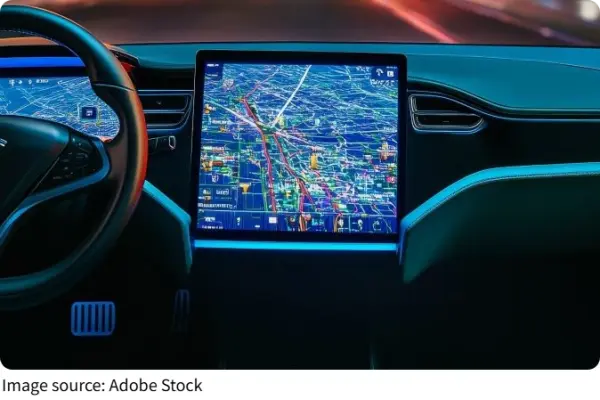
The voice assistant in your car should disappear into the background – helping without demanding attention, understanding without needing repetition. That’s the design goal, and the technology is finally catching up. Large language models bring natural conversation. Smart UX design brings trust.
The next frontier is anticipation – your car offering help before you ask, based on context, time, and habits. But the real test isn’t technical. It’s whether you feel comfortable relying on it with your hands off the screen and your eyes on the road.