Green Walls, Grey Seas
Nolan O'Connor
| 27-07-2026
 · Travel team
Friends, halfway between Scotland and Iceland, eighteen volcanic islands rise from the North Atlantic in vertical green walls of grass and basalt, their clifftops disappearing into fog while waterfalls pour directly into the sea from heights that defy easy belief. The Faroe Islands—an autonomous territory of Denmark—offer one of Europe's most dramatic and least crowded landscape experiences. The green is impossibly vivid, the cliffs impossibly steep, the weather impossibly changeable, and the silence in the valleys between storms impossibly deep. This is a place built for those who find beauty in raw edges
Múlafossur Waterfall
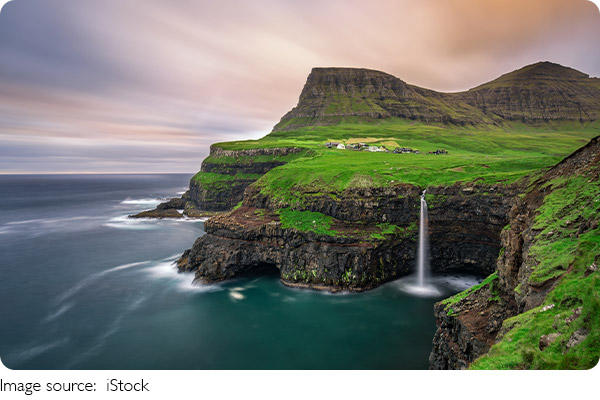
The most photographed scene in the Faroes—a waterfall plunging from a green clifftop directly into the ocean—sits at the village of Gásadalur on the island of Vágar. Since 2004, a tunnel has made Gásadalur accessible by car, just 17 minutes from Vágar Airport. The viewpoint is a five-minute walk from the free parking area. For a more immersive experience, the old Postman's Trail from the neighboring village of Bøur crosses the mountain on a moderate-to-difficult route of approximately 2.5 to 3.5 kilometers, delivering elevated views of sea stacks (Drangarnir, Tindhólmur) and the waterfall itself. No entrance fee applies, though parking spaces are limited—arriving before 9:00 AM avoids congestion.
Hiking the Green
The Faroes offer hiking for every fitness level across terrain that shifts from sea-level coastal paths to ridgeline walks above the clouds. Many of the most spectacular hikes are free, including the route from Tórshavn to the historic settlement of Kirkjubøur along the coast. The Klakkur peak on Borðoy island delivers panoramic views for minimal effort. However, several popular trails on private farmland now require a hiking fee—typically $7 to $15 per person—payable online before arrival. Check the official Visit Faroe Islands website for current fee requirements. Weather changes rapidly and dramatically—waterproof and windproof layers are non-negotiable regardless of the forecast.
Island Hopping
The 18 islands are connected by an efficient network of subsea tunnels, bridges, and ferries. Tunnel tolls cost approximately $5 to $25 per route depending on distance. Inter-island ferries are subsidized and affordable—typically $5 to $15 per passenger depending on the crossing. The ferry from Sørvágur to Mykines island (famous for its summer puffin colonies) costs approximately $20 to $30 round trip and should be booked in advance, as the crossing is weather-dependent and seats are limited. A public bus network connects major villages, with a seven-day travel card offering unlimited rides for approximately $45 to $55—excellent value for car-free travelers.
Getting There
Atlantic Airways operates direct flights to Vágar Airport from Copenhagen (approximately 2 hours), Reykjavík (approximately 1.5 hours), and seasonal routes from other European cities. Round-trip fares range from $350 to $1,000+ depending on origin, season, and advance booking. The Smyril Line ferry connects Hirtshals (Denmark) to Tórshavn, with the crossing taking approximately 36 hours. Ferry fares start from approximately $120 one way for foot passengers and $250+ with a vehicle—a viable option for those bringing their own car.
Car Rental
Renting a car provides maximum flexibility for exploring the islands' narrow roads and remote viewpoints. Daily rates range from $60 to $160 depending on season and vehicle type—compact cars handle the single-lane roads comfortably. Fuel costs add approximately $15 to $35 per day. Total daily driving costs, including tunnel tolls, typically run $80 to $210. Booking well in advance—particularly for summer months—is essential, as rental fleets on the islands are limited.
Where to Stay
Tórshavn, the tiny capital, offers the widest accommodation selection. Hotels range from $150 to $350+ per night, with properties like Hotel Føroyar and Hotel Hafnia providing comfort and central location. Guesthouses throughout the islands cost $80 to $170 per night. Hostels—including the well-regarded Giljanes Hostel near Vágar Airport—offer dormitory beds from $40 to $65 per night. Self-catering cottages and apartments cost $90 to $200 nightly, with kitchen access significantly reducing food costs in a destination where restaurant dining is genuinely expensive.
Food Costs
Dining out in the Faroe Islands is the largest daily expense after accommodation. A casual restaurant meal costs $20 to $30 per main course. A three-course dinner for two at a mid-range restaurant can exceed $140. Pizza and simple café meals run $18 to $22. Grocery shopping—while still roughly 25 percent more expensive than continental European prices—is the most effective budget strategy, with a realistic daily food budget of $20 to $32 per person when self-catering. Local fish dishes at small community eateries offer the best value-to-quality ratio.
Lykkers, the Faroe Islands exist at the intersection of green and grey—emerald grass against slate-colored ocean, sunshine breaking through fog for ten minutes before the clouds return, waterfalls that appear and disappear as cloud cover shifts. It is a landscape that rewards patience, waterproof clothing, and a willingness to be astonished by simplicity. Have you ever traveled somewhere so remote that the absence of crowds felt like the most luxurious amenity of all?