Fourteen Islands, One City
Nolan O'Connor
| 27-07-2026
 · Travel team
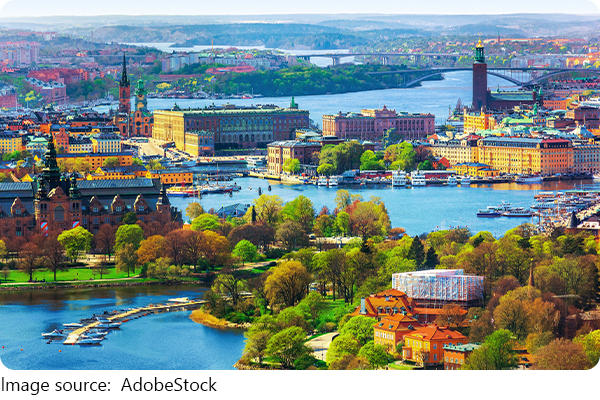
Friends, built across fourteen islands where Lake Mälaren meets the Baltic Sea, Stockholm is a capital city that uses water the way most cities use streets—as the connecting element that gives the entire urban landscape its rhythm. The medieval old town of Gamla Stan occupies one island. Stockholm City Hall—the red-brick waterfront landmark famous for hosting the Nobel Prize banquet—sits on another. Art-covered subway stations tunnel beneath the surface while ferry routes connect neighborhoods that bridges cannot reach. The result is a city where every journey involves crossing water, and where the light reflecting off harbours, channels, and lake surfaces changes the character of every neighbourhood with every shift in the sky.
Stockholm City Hall
Stockholm City Hall (Stadshuset)—completed in 1923 on the eastern tip of Kungsholmen island—is one of Sweden's most recognizable buildings, with its square tower topped by the golden "Three Crowns" symbol visible across the city skyline. The interior—including the Blue Hall (where the Nobel banquet is held) and the Golden Hall (decorated with 18 million gold mosaic tiles)—is accessible only through guided tours. tickets cost approximately $14 (150 SEK), with student/senior tickets at $12 (130 SEK) and youth (7 to 18) at $6 (60 SEK). The 106-meter tower—open May through August—delivers panoramic views across Stockholm's islands and waterways. Tours run daily in English and Swedish. The short walk from Stockholm Central Station takes approximately 10 minutes.
Gamla Stan
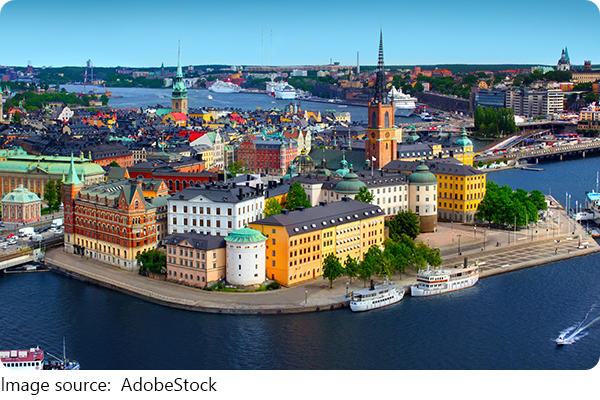
Gamla Stan—Stockholm's medieval old town—occupies a compact island of cobblestone streets, pastel-colored buildings from the 1600s and 1700s, and narrow alleyways so tight that stretching both arms can touch opposite walls. Stortorget, the main square, hosts seasonal markets and serves as the visual centerpiece. The Royal Palace—one of Europe's largest—offers tours of the Royal Apartments, Treasury, and Museum of Antiquities at approximately $22 to $23 (220 to 240 SEK) for adults, with combined tickets including nearby sites at $26 (270 SEK). Children under 7 enter free. Mårten Trotzigs Gränd—the narrowest alley in Stockholm at just 90 centimeters wide—is a short detour worth finding.
Art Underground
Stockholm's subway system (Tunnelbana)—often called the world's longest art gallery—features original artwork in over 90 of its 100 stations. T-Centralen, Kungsträdgården, and Stadion stations are the most photographed, with murals, sculptures, and painted bedrock creating an underground gallery accessible with a standard transit ticket. A single-ride ticket costs approximately $4 (43 SEK), valid for 75 minutes. A 24-hour pass costs $17 (180 SEK), a 72-hour pass $34 (360 SEK), and a 7-day pass $45 (470 SEK). Contactless card payment works on all buses, trains, trams, and ferries—Sweden is nearly cashless.
Vasa Museum
The Vasa Museum—dedicated to a 64-meter warship that sank in Stockholm harbour in 1628 and was recovered nearly intact 333 years later—is the most visited museum in Scandinavia. The ship, preserved at 95 percent original timber, fills the museum's central hall. High-season admission (May through September) costs approximately $23 (240 SEK), with low-season admission at $19 (195 SEK). Visitors aged 18 and under enter free. The museum is located on the island of Djurgården—reachable by ferry, bus, or a pleasant 20-minute walk from Gamla Stan.
Where to Stay
Stockholm accommodation spans all price ranges across its islands. Budget hostels and economy rooms start from approximately $95 to $140 per night. Mid-range hotels in central locations (Södermalm, Norrmalm, Kungsholmen) cost $180 to $260. Luxury waterfront properties run $350 to $500+. The Go City Stockholm All-Inclusive Pass bundles admission to 50+ attractions and can significantly reduce per-attraction costs for visitors planning multiple museum days. Booking summer accommodation (June through August) two to three months ahead secures better rates and availability.
Eating Smart
Stockholm's daily "lunch specials" (dagens lunch)—served at most restaurants between 11:00 AM and 2:00 PM—offer a main course, salad, bread, and coffee for approximately $14 to $18 (145 to 185 SEK)—significantly cheaper than dinner service at the same establishment. A casual dinner at an inexpensive restaurant costs approximately $14 (145 SEK). A three-course dinner for two at a mid-range restaurant runs approximately $76 (800 SEK). Grocery shopping at Willys or Lidl for self-catering keeps daily food costs at approximately $25 to $35 per person. Tap water is excellent quality and free everywhere.
Lykkers, Stockholm is a city where geography dictates experience—the fourteen islands, the bridges between them, the ferries crossing harbour channels, and the subway art tunneling beneath all of it create a travel rhythm that constantly shifts between water, architecture, and light. The Nobel banquet hall inside City Hall, the medieval alleys of Gamla Stan, the recovered warship filling an entire museum, and the painted bedrock of a subway station all exist within a few kilometers of each other, connected by water and walkable bridges. When you think of a capital city, do you picture it on solid ground—or could the most interesting version of a city be one that floats?