Beyond The Wind

Amina Hassan
| 16-08-2026
 · Travel team
Lykkers, have we ever watched a sailboat glide across the sea and wondered how it can move so quickly without an engine? At first, it seems simple: air pushes the sail, and the boat moves forward.
Yet modern sailing craft can reach speeds several times higher than the surrounding breeze. The secret lies in lift, sail shape, and apparent wind.
Why Simple Pushing Falls Short
If a boat simply caught a breeze like a large sheet, its speed would soon reach a limit. Imagine a steady breeze moving at 10 meters per second while the boat is still. As the hull begins moving, the difference between the boat and the airflow becomes smaller. At the same time, resistance from the water grows as speed rises.
Eventually, the forward force and water resistance balance each other. At that point, simple air pressure cannot provide much more acceleration. This explains why our first impression can be misleading. A sailboat is not simply being carried along by moving air.
The Sail Acts Like An Airfoil
When we look at a modern sail from above, its curved shape becomes easier to understand. The two sides are exposed to different airflow paths. Air moves faster along one side and more slowly along the other. This difference creates a pressure difference across the sail.
By setting the sail at a suitable angle, we can turn part of this force into forward motion. The underwater keel or foil also helps control sideways movement, allowing the boat to use the force from the sail more efficiently.

Pressure Creates Lift
This effect can be explained through the relationship between airflow speed and pressure. Where air moves faster, pressure tends to be lower. Where it moves more slowly, pressure tends to be higher. The resulting pressure difference creates lift.
We can imagine air flowing around a curved surface. One stream speeds up while another follows a different path. The difference between them produces a force across the surface. A properly adjusted sail uses this effect to create useful forward movement rather than simply receiving a direct push from behind.
Apparent Wind Changes The Game
Another important detail is the difference between true wind and apparent wind. When we stand on shore, we feel the natural movement of the air. This is known as true wind. Once we begin moving on a sailboat, however, our own motion changes the airflow we experience.
This new airflow is called apparent wind. As the boat accelerates, apparent wind can become stronger and shift toward the front of the boat. We then adjust the sail angle to keep the airflow working efficiently across its surface.
This creates an interesting cycle. The boat gains speed, the apparent wind changes, the sail is adjusted, and the new airflow can provide more lift. With good control, this process allows a sailing craft to keep accelerating even when it is already moving faster than the original breeze.
Direction Matters Greatly
We also need to consider the boat's direction. A sailboat usually performs differently when moving directly with the breeze compared with sailing across it at an angle. In many high-speed sailing situations, the craft travels across the wind rather than simply running straight downwind.
The sail is positioned so that airflow passes around it at an efficient angle. Meanwhile, the underwater surface helps resist sideways movement. Together, these parts allow the boat to convert airflow into forward speed.
Why Speed Eventually Stops Rising
Even with efficient sails, acceleration has limits. As the boat becomes faster, water resistance increases. The apparent wind also changes its direction and strength. At some point, the sail can no longer create enough useful lift to overcome the growing resistance.
Hull shape is another major factor. A narrow and lightweight design can reduce resistance, while efficient underwater surfaces help maintain control. Some modern sailing craft can even rise partly above the water, greatly reducing the amount of water they need to push aside.
The Science Behind The Surprise
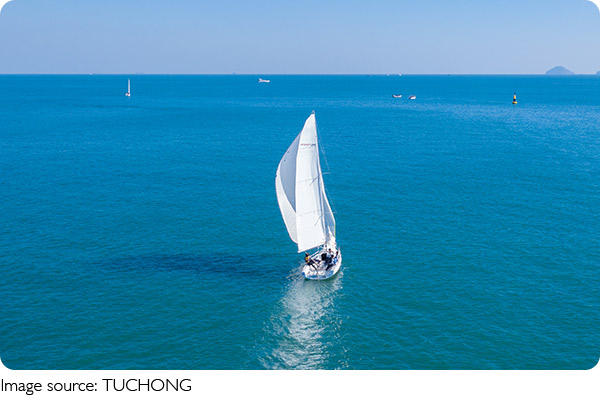
So, Lykkers, a sailboat can indeed move faster than the breeze that initially drives it. The key is that the sail does not simply act like a sheet catching air. It works more like an airfoil, using pressure differences to generate lift. The keel or foil controls sideways movement, while apparent wind changes as the boat accelerates.
The result is a beautiful balance between air and water. When we watch a fast sailboat crossing the sea, we are seeing airflow, pressure, lift, resistance, and steering work together in real time.
Next time we see a sailboat racing across the water, take a closer look at the angle of its sail and its direction of travel. Lykkers, did you expect a boat powered only by wind to move faster than that wind? Share your thoughts and see if this surprising piece of sailing science changes the way we look at the sea.
Why Sailboats Can Go Faster Than the Wind (The Physics You Didn’t Expect)
Video by Science Explainer 101