Bernese Oberland, Simply

James Carter
| 13-11-2026
 · Travel team
Hello, and thank you for reading. The Bernese Oberland is the part of Switzerland that postcards borrow from, but you do not just stare at it from a train window.
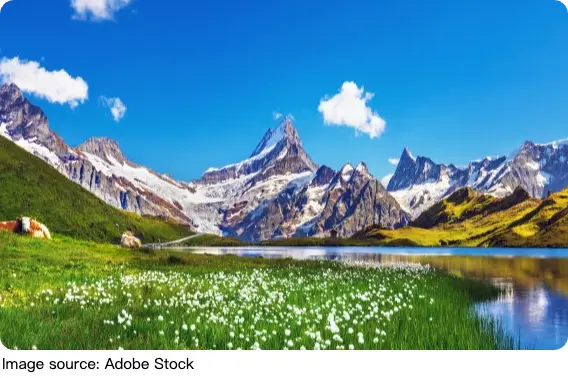
You ride three different cable cars in a day, walk past cows wearing bells the size of your fist, and eat lunch at 2,000 meters while a glacier sits across the valley.
Why this valley earns the trip
The Oberland sits south of Bern and holds the highest, most concentrated cluster of peaks in the country. Interlaken is the usual base, wedged between Lake Thun and Lake Brienz, and from there the two famous valleys branch upward: Lauterbrunnen on one side, Grindelwald on the other. What makes it work is density. Within roughly 40 minutes by train from Interlaken you can be standing under the Staubbach Falls, a 297 meter ribbon of water that drops almost free from the cliff at Lauterbrunnen. Fifteen minutes farther and you're at the base of the Jungfrau railway. Very few regions pack this much vertical scenery into so little travel time.
What to actually see up high
Skip the idea that one summit covers it. The Jungfraujoch, at 3,454 meters, is the headline, reached by a cog railway that climbs inside the Eiger and costs around 200 USD for a standard return from Interlaken, though early booking and regional passes cut that down. The alternative most locals prefer is the Schilthorn, at 2,970 meters, where the revolving restaurant Piz Gloria gives you a full 360 degree sweep of the Eiger, Mönch, and Jungfrau. Two more worth your time: the Trümmelbach Falls, ten glacier-fed waterfalls carved inside a mountain and reached by lift and tunnel near Lauterbrunnen, and the First cliff walk above Grindelwald, a metal walkway bolted to the rock face that ends at a viewing platform. Pick two of these, not all four, or you'll spend the day in transit.
Getting around without a car
Trains, cable cars, and post buses do the job, and honestly they're faster than driving in summer. The key detail is the Berner Oberland Pass, which covers unlimited travel on most trains, buses, and boats in the region plus discounts on the big mountain railways. A three day pass runs roughly 250 to 280 USD for adults, and it pays for itself the moment you add the Schilthorn and a couple of valley trains. From Interlaken Ost, the train to Lauterbrunnen takes about 20 minutes; from there a cable car and train combo gets you to Wengen or Mürren. Book the Jungfraujoch in advance in peak season, because the seats on the upper train sell out on clear days.

Timing your visit right
June through September is the reliable window for high trails, with July and August the busiest and most expensive. Late September brings crisp air and thinner crowds, but some cable cars start closing for maintenance in October and November. Winter flips the whole place into ski terrain, with Grindelwald and Mürren as the main hubs. A practical tip: check the live webcams before buying any summit ticket. Cloud can sit on the Jungfraujoch all morning while Lauterbrunnen valley stays clear, and the ticket desks won't refund you for weather. Build one flexible day into your plan so you can chase the clear sky.
What it costs and where to sleep
Budget around 150 to 250 USD per night for a mid-range hotel in Interlaken, and expect closer to 200 to 300 USD in Wengen or Mürren, where the car-free setting adds a premium. Hostels and guesthouses in Lauterbrunnen start near 60 USD for a dorm bed. Food adds up fast, so many visitors buy picnic supplies at the Coop in Interlaken and eat lunch on a trail. A solid approach: base yourself in one valley town for three nights, take the pass, and let the weather decide each morning.
The takeaway is simple. Treat the Bernese Oberland as a set of layers, valley floor to summit, and give yourself permission to skip one peak in favor of a slow walk through a village like Gimmelwald. Next time you're planning an alpine trip, remember that the best views here often come from the trail, not the ticket gate.