Uyuni Salt Flat Guide

Elena Rossi
| 20-10-2026
 · Travel team
Hi there, readers. You have probably seen the photos: a mirror-flat white plain that reflects the sky so cleanly the horizon disappears.
That's Salar de Uyuni in Bolivia, and it's the largest salt flat on earth at roughly 10,582 square kilometers. But the place is not just one photo op.
It's a high-altitude desert of salt crust, cactus islands, and pink flamingos, and how you visit changes everything about what you get out of it.

Why the flat earns the trip
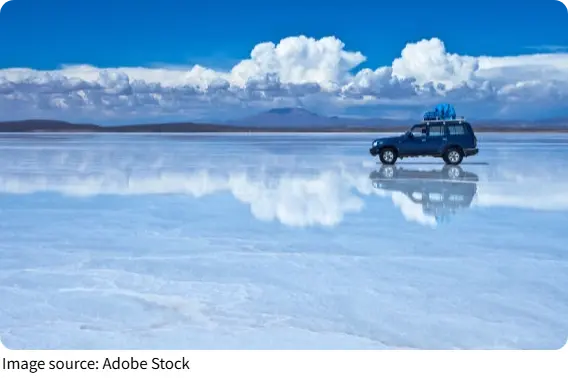
The draw is the sheer scale of nothing. Standing on the crust at 3,656 meters, you see white in every direction until it curves away. In the wet season, roughly December through March, a thin layer of water turns the surface into a mirror and the sky appears under your feet. In the dry season, the crust cracks into hexagonal tiles that stretch for kilometers. Both versions are worth the journey, and they feel like two different places.
What you actually see out there
Most tours run from the town of Uyuni or from Tupiza, and the standard full-day trip hits a few fixed stops. You'll climb Isla Incahuasi, a hill covered in towering trichocereus cacti that sits in the middle of the salt, and you'll stop at the Ojos del Salar, two round sinkholes where groundwater bubbles up. The three-day southwest route adds the red lagoon at Laguna Colorada, where hundreds of James's flamingos feed, and the geyser field at Sol de Mañana, which vents steam at over 4,800 meters. Bring sunglasses with real UV protection. The glare off the salt is brutal.
Getting there and getting around
The usual arrival is a flight from La Paz to Uyuni's small airport, Joaquín de la Quintana, which takes about an hour, or an overnight bus from La Paz that runs roughly 10 to 12 hours. From Uyuni town, you don't drive yourself. You book a guided 4x4 tour, because the routes cross unmarked salt and there's no navigation to rely on. A shared full-day tour typically runs about $30 to $45 per person, and a three-day southwest circuit with transport, meals, and basic lodging usually lands between $150 and $250. Park entry fees are extra, around $10 to $15 at each site.
Timing and booking details
Book your tour at least a day ahead in Uyuni town, and confirm whether the operator includes the park fees or not, because that gap surprises people. The wet season gives you the mirror but can flood routes and close access to some lagoons. The dry season, roughly May through October, gives you reliable roads and clear skies but colder nights, often below freezing in June and July. Whatever season you pick, pack layers. The temperature swing between midday and 3 a.m. on the salt is severe.
Practical tips before you go
Altitude is the thing nobody warns you about enough. Uyuni sits above 3,600 meters, and the southwest route climbs past 4,800, so give yourself a day or two in La Paz to adjust first. Carry cash in Bolivianos, since ATMs in Uyuni town are limited and unreliable. And if you want the mirror photos, ask your operator directly whether the water level is high enough during your dates, because a dry crust and a flooded plain are not the same trip.
The salt flat rewards the people who plan around the season and the altitude rather than just chasing the reflection shot. Pick your window, book your 4x4 in town, and give your body a day to catch up with the height. Then go stand on that white plain and let the horizon do the rest.