Moon Rover Adventure!

Adrian
| 06-11-2026
 · Automobile team
Imagine trying to explore a vast, unfamiliar landscape while wearing a heavy spacesuit and carrying scientific equipment. On the Moon, even walking takes considerable effort, and every journey must be carefully planned.
To make exploration easier, engineers created a compact electric vehicle that could carry astronauts across the lunar surface. Known as the Lunar Roving Vehicle, or Moon buggy, it became one of the most memorable machines of the Apollo missions and gave astronauts a much wider area to investigate.
Why Astronauts Needed a Moon Car
During the early Apollo missions, astronauts explored their landing areas mainly on foot. Although they could collect samples and examine nearby features, walking in bulky spacesuits limited how far they could travel. It also took valuable time and energy to move between points of scientific interest.
A small vehicle offered a practical solution. Instead of relying entirely on walking, astronauts could travel with their equipment and reach locations farther from the lunar lander. This was particularly important for later Apollo missions, which planned longer surface activities and more extensive scientific investigations.
Built for a Very Different Road
The Lunar Roving Vehicle was developed for NASA by Boeing, with important contributions from General Motors' Delco Electronics division. Work began in 1969, and the first completed vehicle was delivered in March 1971. Its design was unlike a typical passenger car.
Measuring approximately 10 feet long and 6 feet wide, the rover had an open structure, two seats, four wheels, and storage areas for tools and scientific equipment. It weighed around 460 pounds on Earth, making it light enough to transport with the lunar lander.
Weight was a major concern because the vehicle had to travel to the Moon inside the spacecraft. Engineers therefore focused on using lightweight materials and a folding structure. Once the lunar module reached the surface, astronauts could deploy the rover without needing a large assembly operation.
Its wheels were also specially designed for lunar conditions. Rather than conventional rubber tires filled with air, the rover used flexible wire-mesh wheels with metal tread elements. This arrangement helped it move across loose lunar soil without depending on ordinary tire pressure.
How the Electric Rover Worked
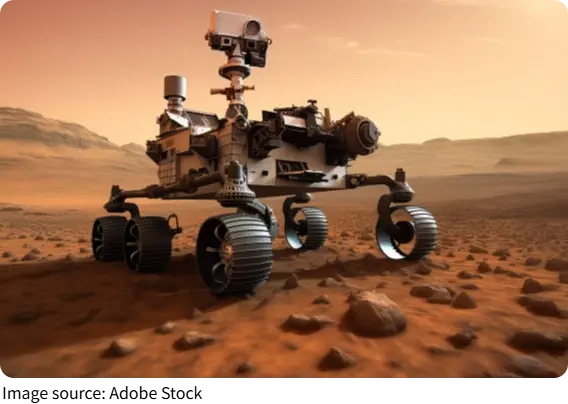
The Moon buggy ran on two 36-volt silver-zinc batteries. Together, they supplied power to four small electric motors, with one motor connected to each wheel. This arrangement provided four-wheel drive and helped the vehicle maintain movement across uneven ground.
Astronauts controlled the rover using a T-shaped hand controller positioned between the seats. Moving it forward or backward controlled the direction of travel, while turning it allowed the driver to steer. The same control system also operated the brakes. The vehicle could reach a maximum speed of approximately 9 miles per hour.
How It Reached the Lunar Surface
Transporting the rover was another engineering challenge. It could not simply be driven into the lunar module, so its structure was designed to fold into a compact package. After landing, astronauts used handles and cables to release and lower the vehicle. Springs and mechanical parts helped move its wheels and other sections into their operating positions. The seats and footrests could then be adjusted before the astronauts climbed aboard.
During Apollo 15, astronauts David Scott and James Irwin completed the deployment process in approximately 40 minutes. Once the rover was ready, they could begin travelling across the surface with scientific equipment and collection tools.
Three Missions That Used the Moon Buggy
The Lunar Roving Vehicle made its first journey on the Moon during Apollo 15 in 1971. It was subsequently used on Apollo 16 and Apollo 17, giving astronauts on all three missions the ability to travel farther from their landing sites. The rover helped crews visit geological locations, examine surface features, and collect lunar material. It also allowed them to carry more equipment without having to transport everything by hand.
Across the three missions, the vehicles covered different exploration distances. Apollo 15 travelled approximately 27.8 kilometres, Apollo 16 covered 26.7 kilometres, and Apollo 17 recorded about 35.9 kilometres of rover travel. Those journeys provided scientists with a broader collection of observations and samples than could have been gathered through short walks around the landing areas.
Although the original rover was built for a specific period of lunar exploration, its contribution remains important. It demonstrated how purpose-built vehicles can extend human mobility beyond Earth and showed that even a relatively compact machine can make a major difference in scientific exploration.