Own the Night Road

Arjun Mehta
| 04-11-2026
 · Automobile team
Hi there. Most drivers treat night driving as daytime with the lights on.
It isn't. Your headlights throw a cone of light maybe 200 feet down the road on low beam, and everything outside that cone is guesswork. The fix isn't better eyes. It's better habits.
Clean glass changes everything
A dirty windshield scatters light from every oncoming set of headlights, and that glare lands right in your line of sight. Wipe the inside of the glass with a microfiber cloth and a glass cleaner, not a paper towel, which leaves lint. Check your wipers too. A streaky wiper turns a light rain into a wall of smeared glare at night. It takes two minutes and you'll notice the difference on the first dark road.
Aim your beams correctly
Misaimed headlights are a quiet blind spot maker. If your beams point too high, you blind oncoming traffic and lose the road right in front of you. Too low, and you can't see past 100 feet. Park on level ground facing a wall about 25 feet away and check where the beam pattern lands. Most cars want the top of the low-beam cutoff around 2 to 3 feet up the wall. Your owner's manual has the exact figure for your model, and most cars have a small dial or fastener for adjustment.
Use the fog line as your guide
When a car approaches with bright lights, don't stare at it. Look down and to the right, toward the white fog line on the shoulder. That line stays lit by your own headlights and gives you a stable reference for your lane position while the oncoming glare passes. Truckers have done this for decades on two-lane highways, and it works just as well in a sedan.
Scan farther than feels natural
At night your instinct is to watch the patch of road right in front of the bumper. Don't. Look 12 to 15 seconds ahead, which at 50 mph is roughly 300 feet down the road. That's beyond your low beams, so you're reading the shape of the road, the tree line, and any reflective signs rather than the pavement itself. A deer stepping out at 150 feet gives you almost no reaction time at highway speed. Seeing the roadside glow earlier buys you a second or two.
Dim the dash, protect your night vision
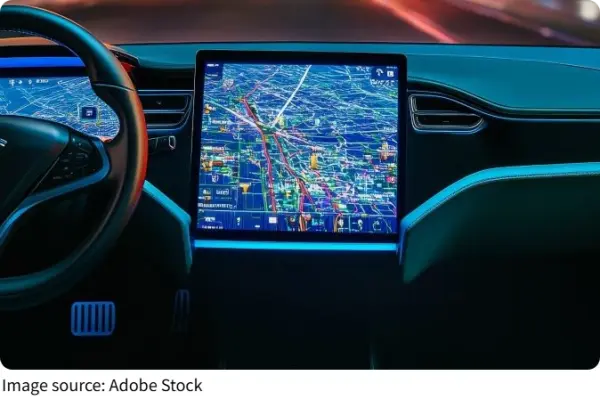
Your eyes need 20 to 30 minutes to fully adapt to darkness, and one blast of a bright dashboard undoes it. Turn the instrument panel brightness down to where you can just read the gauges. Skip the phone mount glowing in your face, too. If a car behind you has blinding high beams, flip your mirror to the night setting, or use the auto-dim if you have it. Small moves, but they keep your pupils wide and your distance judgment sharp.
Know when the brights actually help
High beams roughly double your seeing distance, up to around 350 to 400 feet. Use them on empty rural roads, then drop to low beam within about 500 feet of oncoming traffic and 200 feet behind another car. Many newer cars handle this automatically, but the sensor can miss a motorcycle or a car cresting a hill. Trust your own eyes over the auto setting.
Night driving rewards preparation more than courage. Clean glass, correctly aimed lights, a low dash, and eyes scanning well past the bumper will shrink your blind spots more than any gadget. Next time the sun drops, take the two minutes to wipe the windshield and dim the panel. You'll feel the road open up.